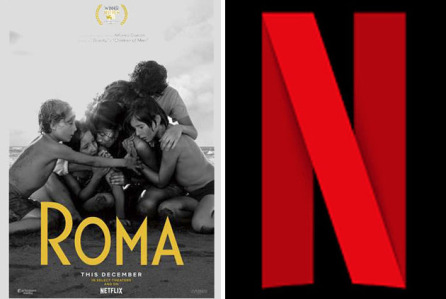
What do Alfonso Cuaron’s “Roma” Oscar wins mean for the future of the Cinema and how Netflix has changed the film market landscape?
This is undoubtedly a first in the modern film industry that is changing rapidly and strives to adapt to the existing logic of international distribution.
Roma, Alfonso Cuaron’s latest movie is a Netflix production and it was streamed in the platform along with a very brief distribution in few theaters internationally. The victory of “Roma” is unquestionable and it signifies a major and critical point in film industry.
Would the work of Alfonso Cuaron also had won the Golden Phoenix at the Cannes Film Festival if the French did not react to Netflix’s logic of distributing the film while at the same time it was streamed on the platform? Thierry Frémaux, Cannes artistic director, announced last May that “Roma” cannot compete in the festival, as in France a film cannot appear on streaming platforms until 36 months after its cinema release, while also commenting that cinema and internet are two completely different things.
After Roma’s Oscar winnings, Steven Spielberg (a member of the Academy’s Board of Governors), also in an attempt to defend the cinema format against streaming, proposed that films which should be eligible for Oscar nominations must have at least a 3 month cinema distribution, otherwise they should be nominated for Emmy Awards, declaring a war between the Academy and Netflix.
So what does Roma’s Oscar victory mean for Cinema?
The creators have just found another powerful ally for funding, that in its own way works as a new production studio and distributor. So more of their work can actually have access to audience without the question of cinema distribution, ticket sales and statistics.
For Netflix it means that it enters dynamically in the arena of film festivals and the Oscars as a big and equal player as the major studios, having also the asset of its platform.
Film festivals must re-examine their rules and also make space for films coming from streaming, in order to keep in touch with the new film industry landscape and be competitive to each other.
For the public, this transition means direct, cheap, remote and legal access to content that otherwise would be offered long after its projection in theaters.
The greatest loser of this game seem to be the cinema halls, for this is a brand new era and a great challenge for them. We are witnessing another step towards the domestic consumption of cinema. There must be given another thought about how the world’s cinemas will offer to people more than just a movie in order to survive. Battling against Netflix and the domestic entertainment demands the offering of a new experience to the audience which remains to be reinvented.

 Invisible Environments
Netflix has been a game changer in so many different aspects of the media landscape, it is comic. Regarding the cinematic environment, I personally feel that this change may be for the good in a particular aspect. Traditional mainstream film studios have been caught in a void of recycling the same content again and again with an endless production of reboots, prequels, sequels and spin-offs for a while now (a great report on this issue can be found here: https://stephenfollows.com/how-original-are-hollywood-movies/). The gigantism of a select few cinematic studios has resulted in the production of conservative content that has nothing new to say.
In this essence, the proliferation of a platform like Netflix could be the seismic shift that those concerned for the future of cinema could be waiting for. It’s interesting that you mentioned Roma, a foreign black and white semi-autobiographical film that is not based on pre-existing material. It is questionable how this film could find its way to production, let alone the Oscars in the pre-Netflix era. That is not to say that independent films did not exist before Netflix, but its presence in the streaming platform definitely resulted in a wider circulation.
So, could Netflix be a stepping stone towards a film landscape with broader representation and diversity, and with new stories to tell? (see here for an interesting study in racial diversity in Hollywood: https://medium.com/@markzt/ready-set-action-examining-racial-diversity-in-mainstream-hollywood-films-4f396c549f20 ). Netflix’s wide international audience creates a fertile ground for the distribution of more diverse stories, and the platform’s “window shopping” format and recommendation algorithms could ensure their broader distribution.
So it is true that along with the cinemas and the film festivals that you mention, traditional film studios should also reexamine their path and think about the content they produce and their restrictions in order to not be outraced.
LikeLike