The self-publishing capabilities of Web 2.0 transformed the internet into a ubiquitous interface for communication and enabled the formation of virtual communities. Generally speaking, virtual communities consist of individuals who exchange common interests, thoughts or feelings online in order to achieve personal or shared goals by performing in various activities and practices including participation, creativity, collaboration and sharing. We define individual participation the degree to which individuals are involved in such online community activities.
Consumers nowadays are participants and content producers contributing actively to value co-creation processes. This behavior shift has been observed by both marketeers and researchers and various approaches have been concentrated on how personal values and personality traits affect individuals’ participation in online communities.
Mai and Olsen in 2015, conducted a study with the use of value-attitude-behavior (VAB) model in order to further explore the relationship between these variables. The results showed that individual attitude towards online community participation has a direct effect on actual participation behavior indicating that VAB model while being an offline model, can also be applied in digital environments. In addition, individuals who are more conservative rather than open to change, are more likely to have negative attitudes and behaviors towards virtual communities. As far as the personality traits are concerned, extraversion is a high predictor on active participation in online environments.
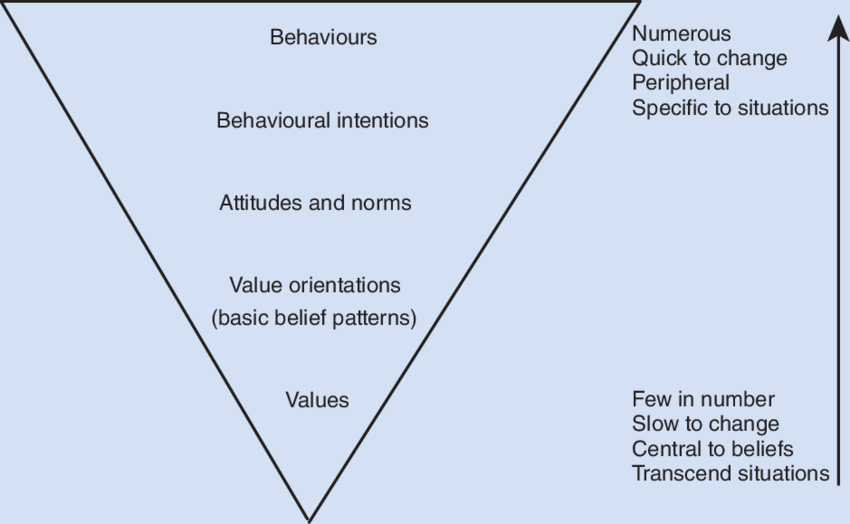
https://www.researchgate.net/figure/The-cognitive-hierarchy-framework-Reprinted-from-Vaske-J-J-Donnely-M-P-1999-A_fig1_250613123
Other studies have focused on individuality and social identity as variables affecting participation in digital communities. Community members can present a unique self in virtual communities’ environments and state their personal opinions on various matters. With this sense of individuality, users perceive themselves as being unique and autonomous and they are motivated to participate regularly in such communities. In addition, social identity (an individual’s self-concept resulted from the membership of a social group) also plays an important role within virtual communities and affects the degree of participation, as it highlights the similarities of the members. Furthermore, social identity is categorized in two forms; Self categorization concerns the degree up to which a user feels similar with the other members and social identification relates with the perception of the member concerning its belonginess in a group along with the feelings evoked by this identity.
In the end, what distinguishes the motivations of participating in an offline community with the motivations of participate on online social environments? Do they differ at all?
References:
Maret, P., Akerkar, R., & Vercouter, L. (2017). Virtual communities, a typology. Web Intelligence (2405-6456), 15(3), 185–187. https://doi-org.acg.idm.oclc.org/10.3233/WEB-170359
Tian-Chao Guo, & Xuemei Li. (2016). Positive Relationship Between Individuality and Social Identity in Virtual Communities: Self-Categorization and Social Identification as Distinct Forms of Social Identity. CyberPsychology, Behavior & Social Networking, 19(11), 680–685. https://doi-org.acg.idm.oclc.org/10.1089/cyber.2016.0290
Mai, H. T. X., & Olsen, S. O. (2015). Consumer participation in virtual communities: The role of personal values and personality. Journal of Marketing Communications, 21(2), 144–164. https://doi-org.acg.idm.oclc.org/10.1080/13527266.2012.736086

 Invisible Environments